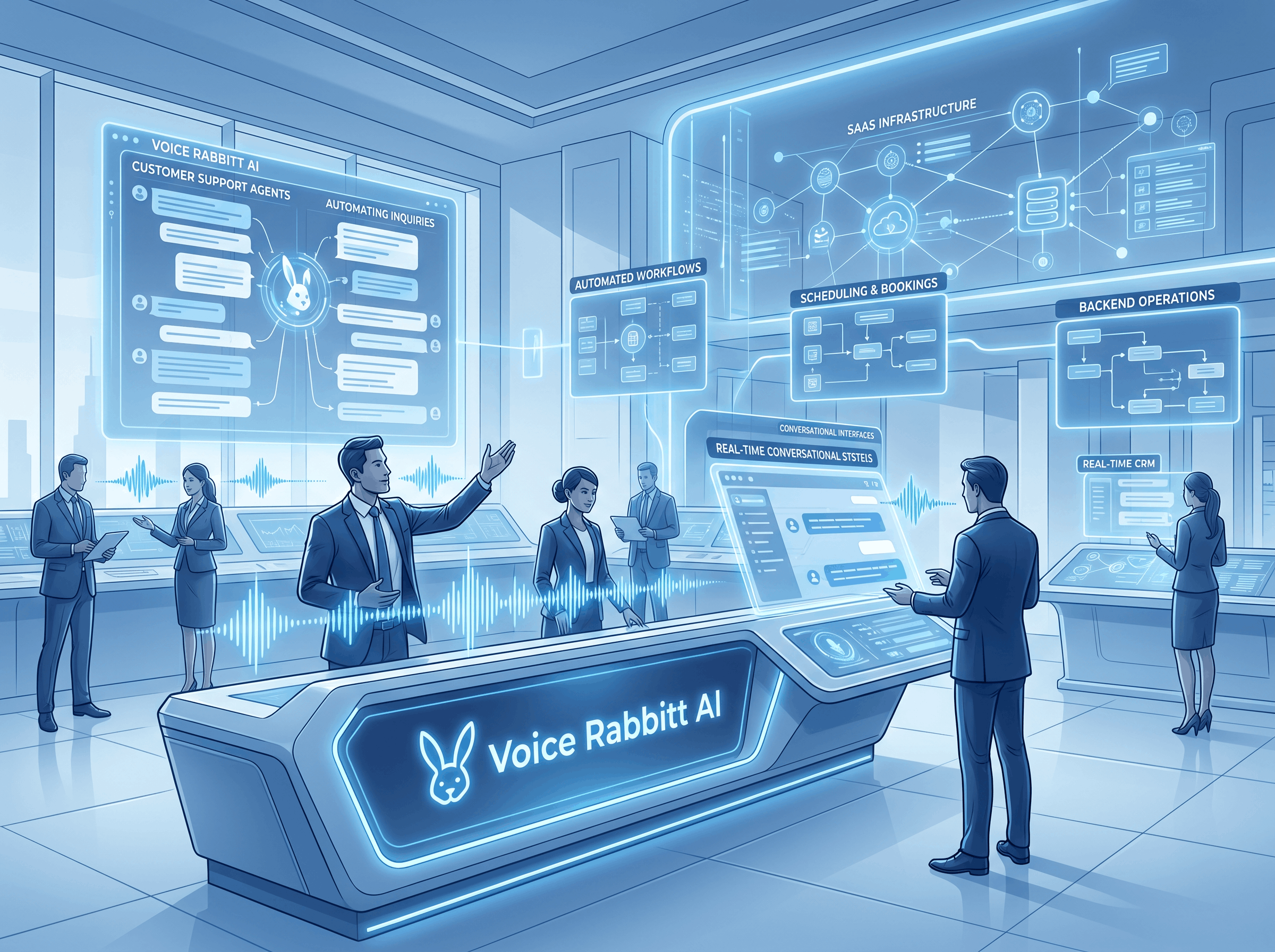

1. The Rise of Conversational Enterprise Systems
Enterprise systems are undergoing a major transition from interface-driven workflows toward conversation-driven operations. For years, businesses depended on dashboards, forms, and support queues to manage customer interaction. As digital systems expanded, these workflows became increasingly fragmented and operationally expensive. Users now expect immediate responses, personalised interaction, and real-time execution without navigating complex interfaces. This shift is accelerating the adoption of conversational AI systems capable of transforming communication into operational action.

Instead of guiding users through multiple screens, AI voice systems can now understand requests, retrieve operational data, execute workflows, and deliver responses instantly through natural conversation.
According to Gartner Research, conversational AI is becoming one of the fastest-growing enterprise automation layers across customer operations and support infrastructure. According to a report by Juniper Research, conversational banking systems are expected to save financial institutions billions annually by automating customer support and transactional workflows. This is one of the primary reasons why banks are rapidly investing in AI-powered customer interaction systems. According to research from Fortune Business Insights, the global conversational AI market is projected to grow significantly over the next decade as enterprises increasingly invest in scalable automation infrastructure and real-time customer interaction systems.
2. Why Businesses Are Replacing Traditional Support Models
Traditional support systems struggle to scale efficiently because every increase in customer interaction requires additional workforce, infrastructure, and operational management.
Voice AI changes this model by enabling businesses to automate repetitive communication workflows while maintaining continuous availability and real-time response capability.
According to McKinsey & Company, enterprises adopting AI-powered customer engagement systems are seeing measurable improvements in operational scalability and customer interaction efficiency.This is why conversational systems are increasingly becoming part of enterprise operational infrastructure rather than standalone support tools.
3. Voice AI in Banking & Financial Services
Banking and financial institutions are among the fastest adopters of conversational AI because customer interaction in financial systems is highly repetitive, operationally sensitive, and time-critical.
Voice AI systems are now being deployed for:
account inquiries with voice biometric authentication,
fraud alert verification,
payment processing,
card blocking workflows,
and real-time transaction assistance.
Instead of waiting in support queues or navigating banking applications manually, customers can complete sensitive workflows through conversational interaction.

This significantly reduces operational pressure on customer service infrastructure while enabling financial institutions to provide continuous 24/7 support without expanding call centre operations. Instead of navigating mobile banking interfaces or waiting in support queues, customers can resolve issues instantly through voice interaction.
This transition is already visible across the banking industry.
Bank of America’s Erica AI Assistant has processed billions of customer interactions since launch, helping users handle account inquiries, payment assistance, and financial management directly through conversational interaction.
Similarly, JPMorgan Chase AI Initiatives are increasingly focused on automating operational workflows, customer interaction, fraud detection, and financial assistance systems through AI infrastructure.
According to Juniper Research, conversational banking systems are expected to save financial institutions billions annually through automation of customer support and transactional workflows.
According to Accenture Banking AI Research, conversational AI systems are becoming central to digital banking transformation strategies focused on automation, personalisation, and operational efficiency.
4. Conversational Commerce in E-Commerce
E-commerce platforms are increasingly using conversational AI to simplify customer interaction across discovery, support, and post-purchase workflows.
Voice AI systems can now:
provide conversational product recommendations,
assist users during shopping journeys,
automate order tracking,
resolve delivery issues,
and process returns or exchanges through natural conversation.
This transforms customer support from a reactive cost center into a continuous conversational experience integrated directly into operational workflows. Instead of forcing users through forms or support queues, conversational AI allows customers to resolve issues through continuous interaction.
This shift toward conversational commerce is already visible across enterprise retail systems.
Amazon AI Shopping Experience is increasingly integrating AI-powered conversational discovery into customer shopping workflows, allowing users to interact naturally during product exploration and support.
Shopify AI Commerce Tools are also focused on enabling merchants to automate customer interaction and operational workflows using AI-powered systems.
Research from Salesforce State of the Connected Customer shows that customers increasingly expect immediate, personalized, and always-available support experiences across digital commerce platforms.
Research from Salesforce State of Service Report shows that customers increasingly expect faster, personalized, and always-available support experiences across digital commerce platforms. The result is a major operational shift:
customer support evolves from a reactive cost center into a scalable conversational experience integrated directly into business operations.
5. AI Voice Automation in SaaS Platforms
SaaS platforms are increasingly adopting conversational AI to reduce onboarding friction, automate technical support, and improve customer retention.Traditional SaaS support systems rely heavily on documentation, ticketing systems, onboarding calls and manual troubleshooting workflows.As software ecosystems become more complex, support operations become difficult to scale efficiently.Conversational AI changes this by embedding guidance and workflow automation directly into user interaction. Modern AI voice systems can adapt onboarding based on user experience level, guide users through platform setup, automate troubleshooting workflows, assist with feature discovery, and resolve repetitive technical queries without requiring human escalation. This creates a significantly more adaptive and scalable support experience.Zendesk CX Trends Report highlights that AI-powered support systems are rapidly becoming foundational components of SaaS customer operations infrastructure.
Similarly, HubSpot AI Customer Platform focuses heavily on conversational automation across customer onboarding, support, and engagement workflows.SaaS WorkflowConversational AI CapabilityUser OnboardingAdaptive conversational guidanceFeature DiscoveryNatural interaction-based assistanceTroubleshootingAutomated support workflowsSubscription SupportConversational account managementTechnical QueriesReal-time AI assistance
Some enterprise SaaS environments are already reporting substantial reductions in repetitive support tickets after deploying conversational automation systems across customer operations.The broader shift is clear: software platforms are evolving from interface-heavy systems into conversational operational environments where users interact through dialogue instead of documentation-heavy workflows.
6. Operational Benefits of Voice-Driven Workflows
The rapid adoption of conversational AI is being driven less by experimentation and more by operational efficiency. Businesses today are managing significantly larger volumes of customer interaction while simultaneously facing pressure to reduce response times, improve scalability, and maintain continuous service availability.
Traditional communication workflows depend heavily on human-operated systems, making them difficult and expensive to scale over time. Voice-driven automation changes this model by allowing organizations to automate repetitive customer interaction while maintaining real-time engagement across support, onboarding, scheduling, and operational workflows.
Instead of expanding workforce size to manage increasing interaction volume, businesses are increasingly deploying conversational systems capable of handling thousands of simultaneous interactions without operational disruption. This allows organizations to reduce communication bottlenecks while improving consistency and execution speed across customer operations.

According to research from Deloitte AI Institute, organizations integrating AI operational systems are increasingly prioritizing workflow automation and customer interaction efficiency as core business objectives. The report highlights that enterprise AI adoption is increasingly focused on operational scalability rather than isolated experimentation.
As conversational infrastructure becomes more integrated into enterprise systems, communication itself is evolving into an executable workflow layer capable of automating operational coordination in real time.
7. How Conversational Infrastructure Works
Conversational AI systems operate by connecting natural interaction directly with operational infrastructure.
When users speak, the system captures voice input, processes speech, identifies intent, retrieves relevant operational data, and executes workflows through connected APIs, CRM platforms, scheduling systems, support infrastructure, and enterprise databases. The response is then delivered naturally through conversational interaction.
Unlike traditional support systems that separate communication from execution, conversational infrastructure allows conversations themselves to function as operational triggers. This enables businesses to automate workflows dynamically through natural interaction instead of relying on manual navigation or fragmented support processes.

Modern conversational platforms are increasingly designed to integrate communication, workflow orchestration, operational execution, and enterprise automation into unified systems capable of handling real-time customer interaction at scale.
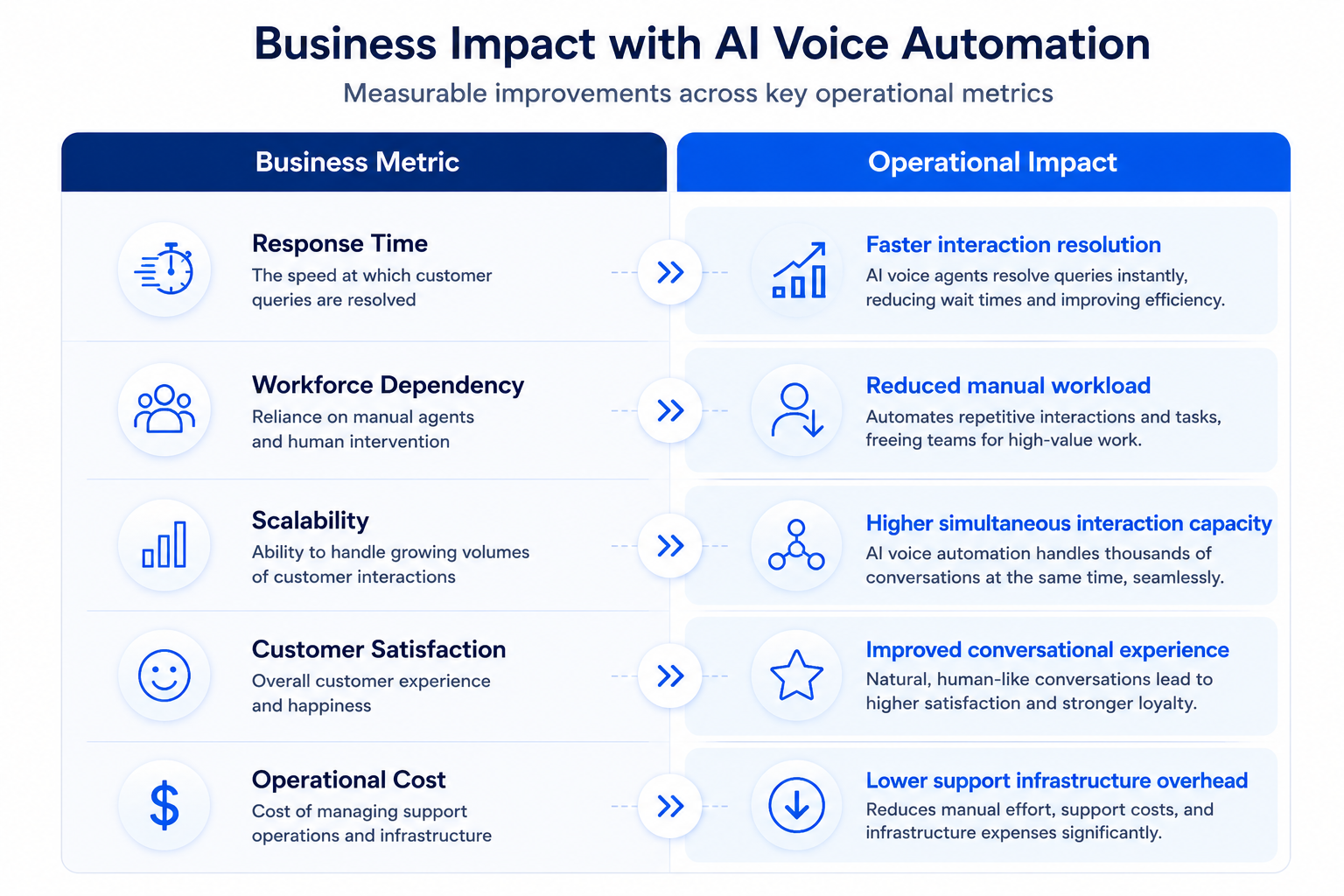
Platforms like Rabbitt AI are helping businesses deploy conversational infrastructure that bridges the gap between communication and backend execution through scalable AI voice automation systems.
8. Future of Enterprise Voice AI
The future of enterprise systems is becoming increasingly conversation-driven.
As conversational AI models continue advancing, businesses are gradually shifting away from interface-heavy workflows toward systems where communication itself becomes the operational layer. Instead of navigating dashboards, forms, or support queues, users increasingly expect systems to understand intent, retrieve information, and execute workflows instantly through natural interaction.This transition is accelerating across industries because conversational systems reduce operational friction while improving scalability and customer experience simultaneously.

According to Gartner Predictions on Agentic AI, autonomous conversational systems are expected to handle a growing percentage of customer operations without human intervention over the coming years.
Research from McKinsey & Company also suggests that organisations embedding AI directly into operational workflows are beginning to see measurable efficiency gains across customer engagement and enterprise automation systems.
This shift is redefining how businesses scale communication, automate workflows, and build operational infrastructure for the AI-first era.
9. Frequently Asked Questions About Voice Rabbitt AI
1. What is Voice Rabbitt AI?
Voice Rabbitt AI is an enterprise conversational AI platform that enables businesses to deploy intelligent AI voice agents capable of automating customer interaction, workflow execution, onboarding, scheduling, and operational communication through natural conversation.
2. How does Voice Rabbitt AI work?
Voice Rabbitt AI combines conversational AI, speech recognition, workflow orchestration, and backend integrations to process customer requests and execute actions automatically in real time. The platform connects directly with APIs, CRM systems, databases, and operational infrastructure to transform conversations into executable workflows.
3. Which industries can use Voice Rabbitt AI?
Voice Rabbitt AI supports industries including healthcare, banking, e-commerce, SaaS, logistics, hospitality, education, travel, and customer support environments where businesses need scalable conversational automation and real-time customer interaction.
4. How is Voice Rabbitt AI different from traditional chatbots or IVR systems?
Unlike traditional chatbots or IVR systems that rely on scripted flows and menu-based interaction, Voice Rabbitt AI enables natural human-like conversation while dynamically executing workflows across connected enterprise systems. The platform functions as conversational infrastructure rather than a static communication layer.
5. Why are businesses adopting Voice Rabbitt AI?
Businesses are adopting Voice Rabbitt AI to automate repetitive communication workflows, improve operational scalability, reduce support costs, deliver faster customer interaction, and build AI-powered conversational infrastructure capable of handling real-time enterprise operations.