
1. The Interface Problem Nobody Talks About
Every customer service call routed through five menu options. Every support ticket requiring three different dashboards. Every appointment demanding the same information twice. These aren't minor inconveniences—they're operational bottlenecks costing businesses millions in lost efficiency and customer satisfaction.
For decades, we've designed digital systems around what computers could do easily: menus, forms, buttons, and workflows. But today's customers don't want to navigate interfaces. They want outcomes.
![Firefly_Gemini Flash_[Image Suggestion]_Split-screen illustration showing traditional dashboards and forms 998970.png](https://blogs-posts.s3.ap-south-1.amazonaws.com/TCImages/1778847967638_0onz7)
By 2028, at least 70% of customers are expected to begin their customer service journey through conversational AI interfaces. Modern enterprises are increasingly investing in AI voice automation, conversational AI platforms, and intelligent workflow execution systems to reduce operational friction and improve customer experience.
The question is no longer whether to adopt conversational AI, but how quickly can your business make the transition.
2. From Chatbots to Conversational Infrastructure
Traditional chatbots operate on a simple principle: respond to questions with pre-programmed answers. They're essentially interactive FAQ pages.
Voice AI automation is fundamentally different.
Unlike traditional chatbot systems, modern AI voice platforms combine conversational AI, workflow automation, backend execution engines, and enterprise operational infrastructure into a unified system. Instead of just answering "What's my order status?", a voice AI system can retrieve the order, check shipping information, identify issues, update the customer, reschedule delivery, and update your CRM—all through a single natural conversation.
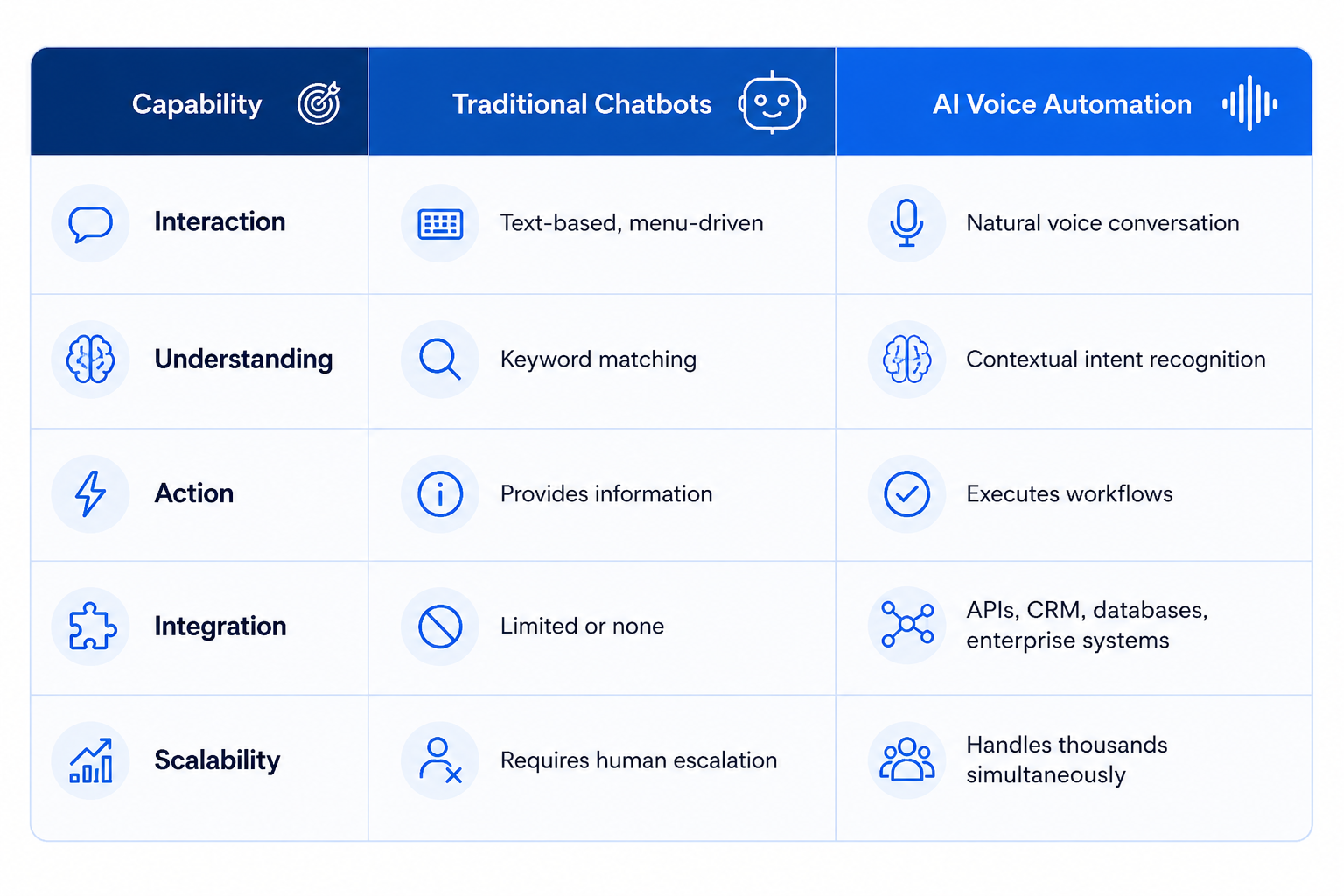
Capability Traditional Chatbots AI Voice Automation Interaction Text-based, menu-driven Natural voice conversation Understanding Keyword matching Contextual intent recognition Action Provides information Executes workflows Integration Limited or none APIs, CRM, databases, enterprise systems Scalability Requires human escalation Handles thousands simultaneously
This transformation from communication tool to operational infrastructure is why McKinsey & Company research highlights that AI-enabled customer service is becoming one of the fastest routes for businesses to deliver scalable and personalized customer experiences.
3. Why Voice Automation Is No Longer Optional
The operational pressure is mounting from every direction:
Customer expectations have fundamentally changed. Your customers expect instant, intelligent service for complex business transactions. Waiting on hold or navigating phone trees feels archaic.

Support costs are unsustainable. According to the McKinsey Global Survey on AI 2025, nearly 88% of organizations now report using AI in at least one business function. Traditional support models don't scale economically.
The market is moving fast. Fortune Business Insights projects the conversational AI market will reach $82.46 billion by 2034, growing from $14.79 billion in 2025—a compound annual growth rate of over 21%.
Gartner predicts that by 2029, agentic AI systems could autonomously resolve up to 80% of common customer service issues while significantly reducing operational costs.
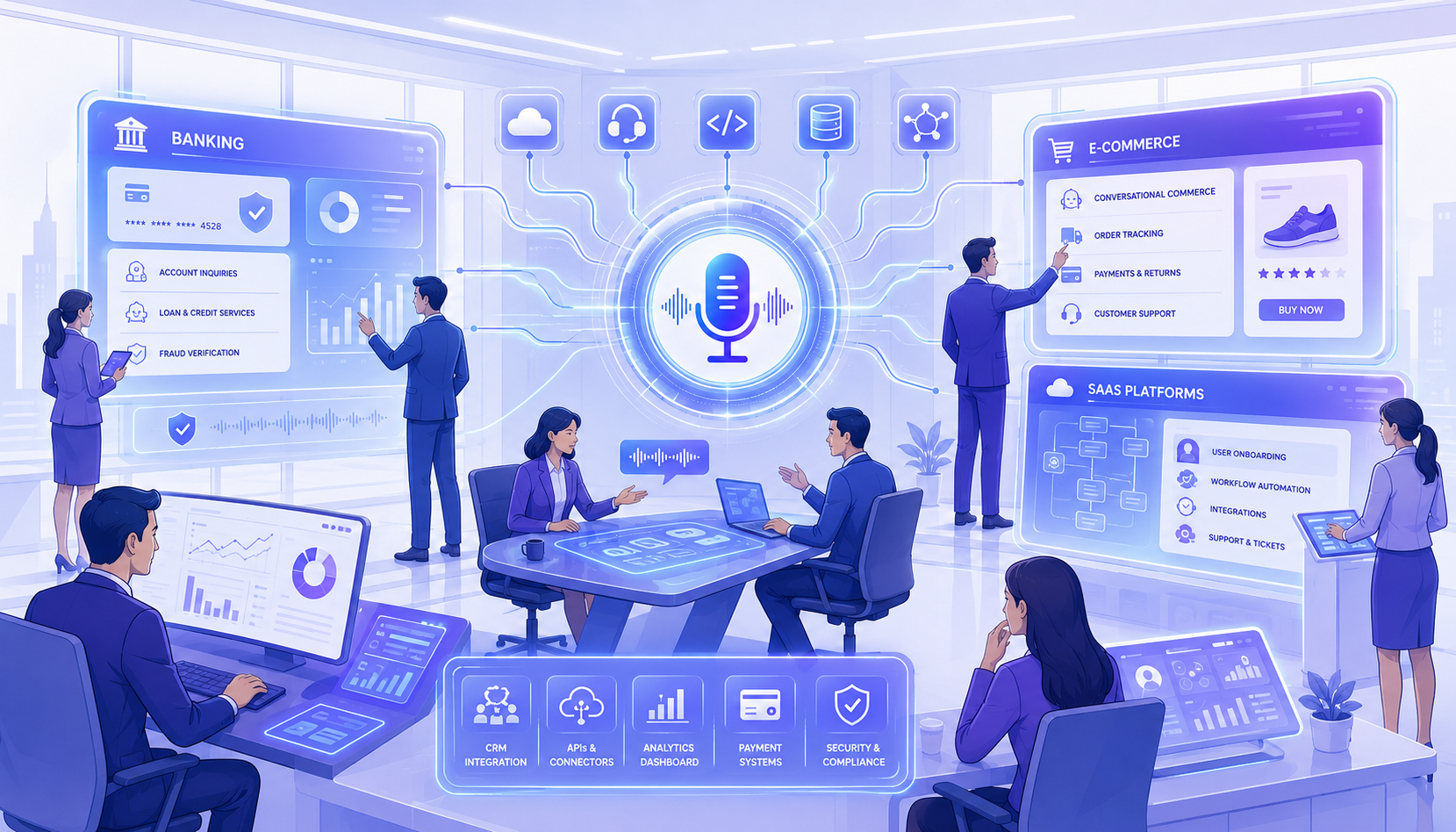
4. Industries Being Transformed Right Now
Healthcare
Automated appointment scheduling with real-time calendar integration
Patient reminders for appointments, medications, and follow-ups
Insurance verification and pre-authorization workflows
Result: 40-60% reduction in administrative workload

Banking & Financial Services
Account inquiries with voice biometric authentication
Fraud alert verification and card blocking workflows
Payment processing with multi-factor confirmation
Result: 24/7 service without expanding call centers

E-commerce
Product recommendations through conversational discovery
Order tracking with proactive problem resolution
Returns and exchanges processed entirely through conversation
Result: Customer service transforms from cost center to seamless experience

SaaS & Enterprise Platforms
Conversational onboarding that adapts to user experience level
Technical support with automated troubleshooting
Feature discovery through natural dialogue
Result: Up to 70% reduction in support tickets

5. The Voice Rabbitt AI Difference
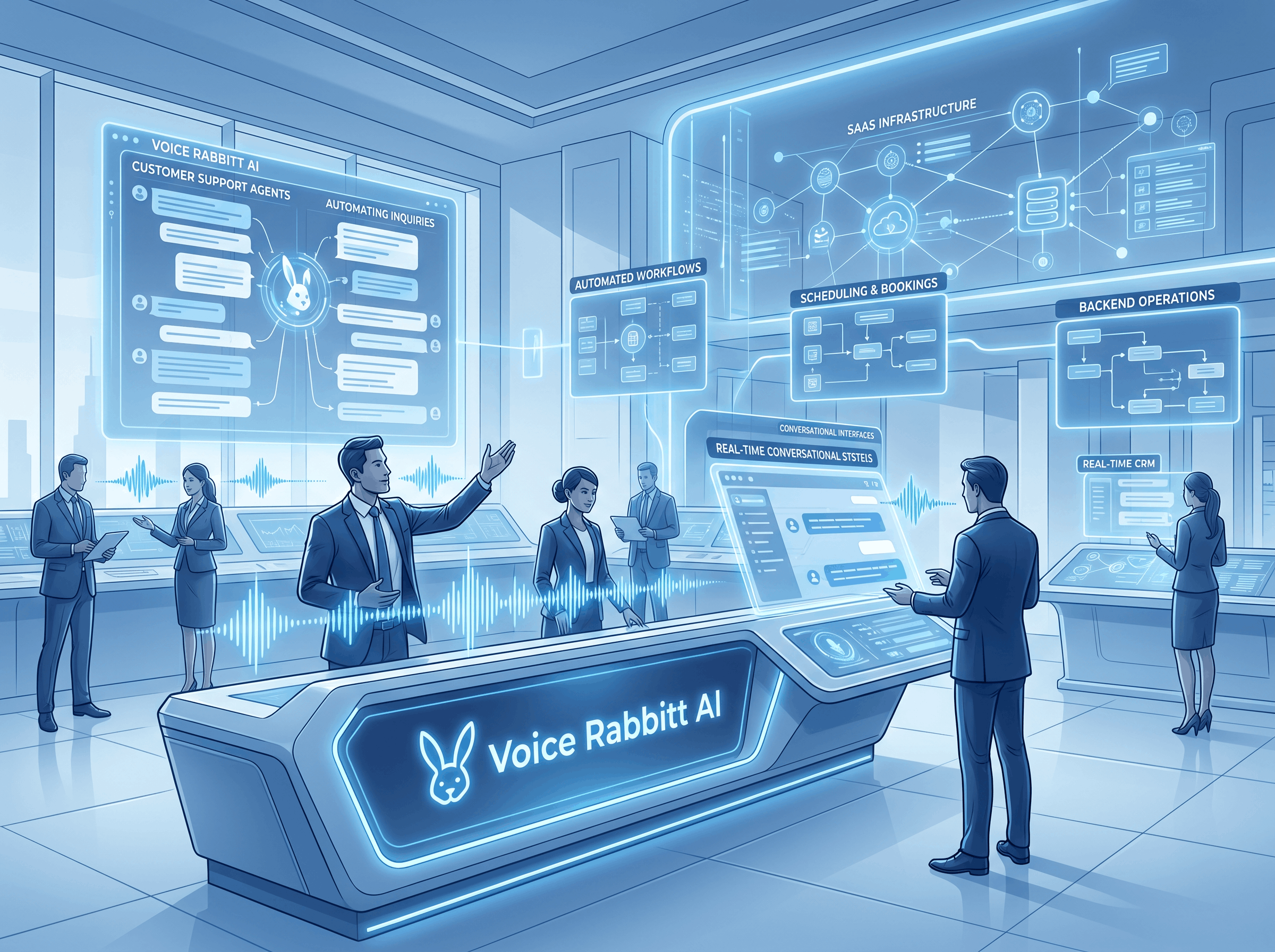
Voice Rabbitt AI represents enterprise-grade conversational AI infrastructure that bridges the gap between communication and execution. The platform combines:
Human-like voice conversation that feels natural, not robotic
Advanced contextual understanding that maintains conversation flow
End-to-end workflow automation that completes tasks, not just discusses them
Deep enterprise integration with CRM systems, APIs, databases, and operational tools
Real-time execution with latency measured in milliseconds
Unlimited scalability handling thousands of simultaneous conversations
How It Works: From Speech to Action
Speech Capture & Processing - Converts natural speech into text with high accuracy
Intent Recognition - Understands what the customer actually wants
Contextual Understanding - Maintains conversation context and memory
Workflow Orchestration - Determines which backend systems need to activate
System Integration - Connects in real-time with your enterprise tools
Action Execution - Performs the actual task automatically
Natural Response - Delivers outcomes through conversational responses
This entire sequence happens in seconds.
Beyond Communication: Executable Intelligence
Voice Rabbitt AI doesn't sit on top of your existing systems as another interface layer. It becomes part of your operational infrastructure—transforming customer conversations into real-time operational execution through AI voice automation, backend workflow orchestration, CRM integrations, and conversational infrastructure systems.
When a customer speaks, Voice Rabbitt AI doesn't just respond. It acts:
Triggers workflows automatically based on intent
Updates CRM systems with conversation outcomes
Schedules appointments across integrated calendars
Retrieves operational data from multiple sources
Processes customer requests end-to-end
Executes backend actions without human intervention
6. Getting Started
Voice Rabbitt AI serves healthcare, banking, SaaS, logistics, hospitality, e-commerce, education, and enterprise customer support environments requiring scalable AI voice automation and conversational workflow infrastructure.
Implementation Made Simple
Integration is designed for your existing stack. Connect with tools you already use: Salesforce, HubSpot, ServiceNow, custom APIs, legacy databases, and scheduling systems.
Deployment can be phased. Start with one high-impact use case—appointment scheduling, order status inquiries, or support triage. Prove value, then expand.
ROI is measurable from day one. Track metrics that matter: call resolution time, customer satisfaction scores, support ticket reduction, and staff hour savings.
What to Consider
Define your highest-impact use case first - Where is your team spending the most time on repetitive conversations?
Audit your integration requirements - What systems need to connect? What data needs to flow?
Establish success metrics - How will you measure impact? Common KPIs include first-call resolution rate, average handling time, and customer satisfaction.
The Competitive Window Is Closing
Early movers are building advantages that will compound over time: better customer data, optimized conversation flows, trained systems, and established customer expectations for self-service.
The future of business isn't about better interfaces. It's about no interfaces at all—just intelligent conversations that understand intent and execute outcomes.
Ready to explore how Voice Rabbitt AI can transform your operations? Let's talk about your specific use case and build a roadmap for implementation.
7. Frequently Asked Questions
How is Voice Rabbitt AI different from traditional IVR systems?
Unlike traditional IVR systems that rely on rigid menus and scripted interactions, Voice Rabbitt AI enables natural human-like conversations while dynamically executing workflows across connected systems. Customers can speak naturally without pressing buttons or navigating menu trees, and the system understands intent, maintains context, and completes complex tasks automatically.
Can Voice Rabbitt AI integrate with our existing CRM and business systems?
Yes. Voice Rabbitt AI is built for enterprise integration and connects seamlessly with major CRM platforms (Salesforce, HubSpot, Zoho), customer support tools, scheduling systems, databases, and custom APIs. The platform uses standard integration protocols, making it compatible with both modern cloud applications and legacy enterprise systems.
How long does it take to implement Voice Rabbitt AI?
Implementation timelines vary based on use case complexity and integration requirements, but most businesses can deploy their first voice automation workflow within 2-4 weeks. The process is designed to be phased—start with one high-impact use case, prove value, then expand to additional workflows. No extensive coding or technical expertise is required from your team.
Is Voice Rabbitt AI secure enough for sensitive customer data?
Absolutely. Voice Rabbitt AI is built with enterprise-grade security including end-to-end encryption, compliance with HIPAA, GDPR, and SOC 2 standards, voice biometric authentication options, and role-based access controls. The platform processes sensitive information securely and can be configured to meet your specific industry compliance requirements.
What kind of ROI can we expect from Voice Rabbitt AI?
Most businesses see measurable ROI within the first 3-6 months through reduced call handling time (40-60% improvement), lower support costs (by eliminating repetitive manual tasks), increased customer satisfaction scores, higher first-call resolution rates, and the ability to scale customer interactions without proportionally increasing staff. Specific ROI depends on your use case, call volume, and current operational costs, but the platform provides detailed analytics to track performance metrics from day one.