
1. The Availability Gap Costing Travel Businesses Real Revenue
Travel decisions are rarely made during business hours. Customers research destinations late in the evening, compare packages over weekends, and make booking decisions the moment they feel ready not the moment your office opens. Yet most travel agencies still operate on a 10 to 7 model, leaving a wide window every single day where inquiries go unanswered and potential bookings walk directly to competitors.
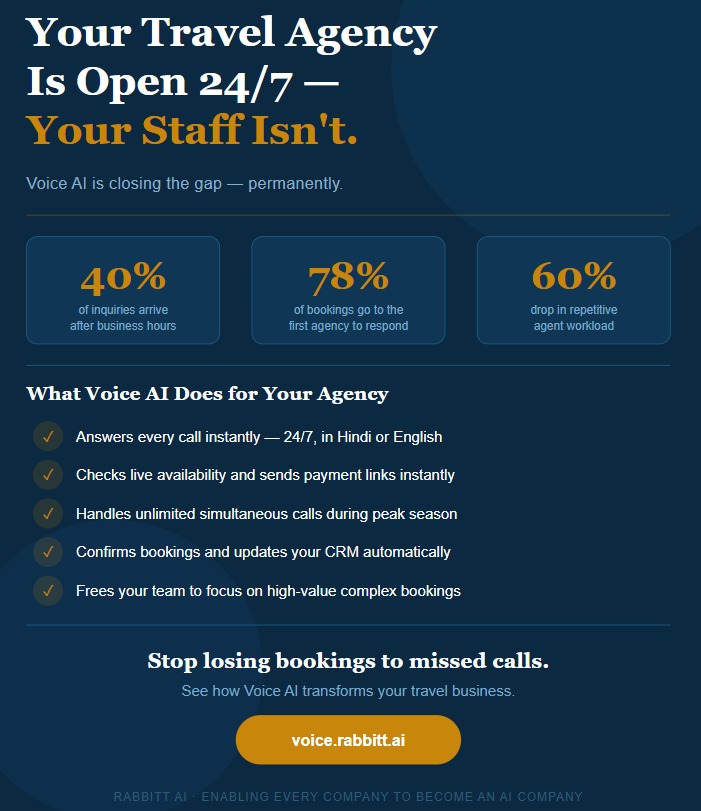
This isn't a minor inconvenience. In an industry where the first agency to respond consistently wins the business, every unanswered call after hours is a booking that belongs to someone else. The average travel inquiry has a decision window of under 24 hours — and for most agencies, a significant portion of that window falls completely outside staffed hours.
The gap between when customers want to book and when travel businesses are available to take those bookings is the single most addressable revenue problem in the industry today. And it has a clear solution.

2. Why Traditional Staffing Cannot Solve This Problem
The instinctive response to an availability gap is to hire more people. In practice, this approach runs into fundamental limitations that no amount of recruitment can solve.
Extended-hours staffing requires people who are trained on your packages, pricing structures, availability systems, and cancellation policies and available evenings, weekends, and public holidays without exception. The cost of maintaining this coverage quickly exceeds the revenue it recovers. And even with expanded headcount, human teams face an inescapable constraint: one agent can handle one conversation at a time.
During peak season, when inquiry volume spikes by 300% or more, even a well-staffed team reaches its ceiling. Customers wait on hold. Calls get dropped. Agents make errors under pressure. The problem doesn't go away it just gets more expensive to manage.


3. What AI Voice Bots Actually Do — Beyond the Buzzword
AI voice bots in 2025 are not the rigid, menu-driven IVR systems that have frustrated customers for decades. They are conversational AI systems capable of understanding natural language, maintaining context across a full conversation, and taking real operational actions not just providing information.
A customer calls asking about a Kerala package for four people, budget ₹80,000, travelling in November. The system does not present a list of options and ask them to press a number. It asks the relevant follow-up questions like departure city, preference for houseboat stay or Ayurvedic retreat, whether they need airport transfers processes those answers in real time, checks live availability, and presents suitable options in a natural, conversational format.
Beyond that conversation, the system can send a payment link via SMS, confirm the booking, trigger a follow-up message the next day, and update your CRM all without human involvement. The entire interaction, from first ring to confirmed booking, can be completed autonomously.

4. Managing Peak Season Without Operational Chaos
Peak season in travel is both the greatest opportunity and the most operationally stressful period for any agency. December, summer school breaks, Diwali travel windows inquiry volume can spike by three to four times normal levels almost overnight. Teams that handle 40 calls a day are suddenly fielding 150, with no infrastructure to support the difference.
The result is predictable: calls go unanswered, customers wait on hold for extended periods, agents make mistakes under pressure, and the agency loses bookings at precisely the moment it should be capturing the most revenue. This is not a people problem. It is a capacity problem, and it cannot be solved by asking the same team to work harder.
AI voice automation removes the ceiling entirely. Every caller gets the same quality of response regardless of volume, time of day, or how many other people are calling at the same moment. Peak season becomes a period of maximum capture rather than maximum stress.

5. The Human Element Redirected, Not Replaced
A common concern among travel business owners is that automating customer conversations will strip the personal quality that differentiates their agency. This concern deserves a direct answer.
Travel is a high-touch, relationship-driven industry. Customers booking a honeymoon or a milestone anniversary trip want to feel genuinely understood. That kind of engagement requires human intuition, empathy, and experience none of which AI replaces. What AI voice automation does is remove the volume of repetitive, low-complexity interactions that currently consume the majority of your team's time.
The reality for most travel agencies is that experienced consultants spend a large portion of their day answering identical questions: visa requirements for a specific country, package inclusions, payment terms, cancellation policies. These interactions deserve accurate, fast responses but they do not require your most skilled people. When AI handles this layer, your consultants can give their complete attention to the clients and conversations that genuinely benefit from human expertise.
The result is not a less personal agency. It is a more focused one where human capability is applied where it creates the most value.
6. Travel Segments Being Transformed Right Now
AI voice automation is not a single-use solution. Across the travel industry, different business types are applying it to the specific operational challenges most relevant to their model.

7. Integration With Your Existing Systems
One of the most practical concerns travel businesses raise about AI voice automation is whether it will work alongside the tools they already depend on. The answer is straightforward: modern AI voice platforms are built for integration, not replacement.
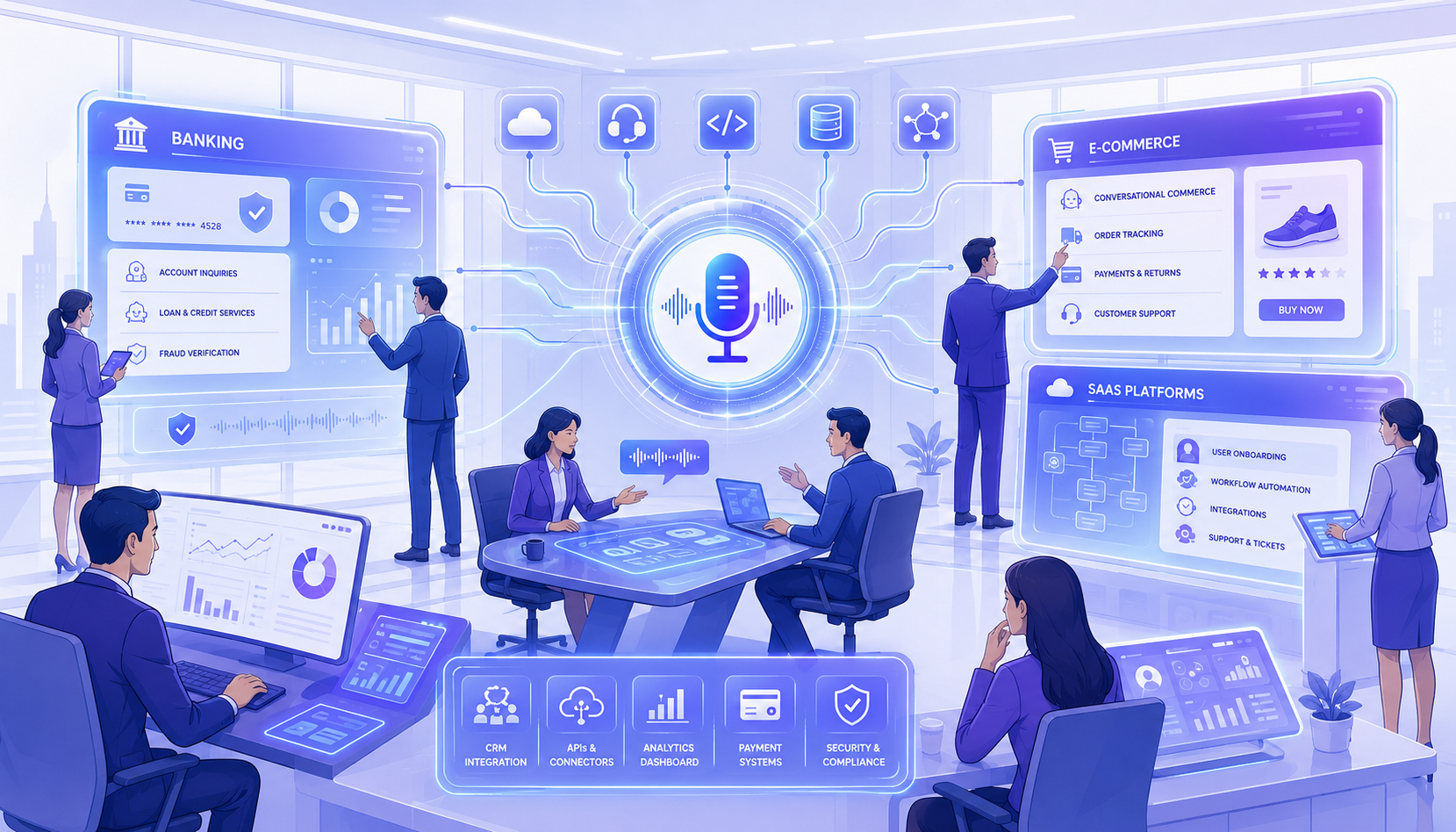
Connection with major CRM platforms allows customer interaction data to flow directly into your existing records without manual entry. Integration with booking and inventory management systems enables real-time availability checks within the conversation itself. WhatsApp Business connectivity means payment links and booking confirmations reach customers through the channel they already prefer.
The system does not require your team to learn a new interface or change how they work. It operates in the background, handling the conversations that would otherwise go unanswered, and surfaces the information your team needs when human involvement is actually required.
8. The ROI Case What Travel Businesses Actually See
The business case for AI voice automation in travel is not theoretical. It is built on a straightforward calculation: how many inquiries currently go unanswered, what is the average booking value, and what percentage of those inquiries would have converted with an immediate response.
For a mid-size travel agency handling 60 to 80 calls per day, industry data suggests that 30 to 40 percent of inquiries arrive outside staffed hours. At an average booking value of ₹60,000 to ₹1,50,000, even a conservative conversion rate on recovered after-hours inquiries produces a return that substantially exceeds the cost of the system within the first month of operation.
Beyond recovered revenue, the operational benefits compound over time reduced agent burnout, higher customer satisfaction scores, more consistent information delivery, and the ability to scale without proportionally increasing headcount.

Frequently Asked Questions
Is customer data handled securely?
Yes. The platform is built with enterprise-grade security including end-to-end encryption, compliance with applicable data protection regulations, and role-based access controls. All customer information shared during a conversation is processed and stored securely. The system can be configured to meet specific compliance requirements relevant to your operating market.
What happens when a customer asks something the system cannot handle?
The system escalates clearly and professionally. When a conversation reaches a point that requires human judgment an unusual request, a sensitive complaint, or a query outside its configured knowledge it flags the interaction, captures a complete summary of the conversation, and routes it to the appropriate person on your team. No customer falls through the cracks. They either receive an instant resolution or a well-informed human follow-up.
Can it handle the complexity of travel inquiries like packages, visa, custom itineraries?
Yes. The system is designed for multi-step, context-dependent conversations. A customer can ask about a package, request modifications based on budget, ask detailed questions about inclusions and visa requirements, and proceed to booking confirmation all in a single, uninterrupted conversation. The more thoroughly your packages, policies, and pricing are defined in the system, the more effectively it handles nuanced queries.